THE PAPER TRAIL OF POWER

From the Epstein Class to the Predator Class — and How We Fight Back

Theodore Roosevelt called them the “malefactors of great wealth.” The phrase was precise for its time — men who did wrong with their fortunes, who corrupted the political system in which they operated, who treated democratic accountability as an inconvenience to be purchased away.

A century later, Heather Cox Richardson has given this network a name that I find more precise: the Predator Class.1 The term has roots — economist James K. Galbraith wrote of the Predator State in 2008,3 and CBS News’s Dick Meyer identified an “economic predator class” as early as 20034 — but Richardson applies it with fresh urgency to the network the Epstein files have now illuminated.

I want to use that phrase, because it is more accurate. A malefactor merely does wrong. A predator hunts. It selects targets. It is organized, patient, and systematic. It does not accidentally cause harm — it is structured around the causing of harm to others for its own benefit.

And yet it is worth pausing here to note that not every member of the Predator Class is a conscious predator. As I discussed in my Epsteinland series,2 the neuroscience of wealth and power is relevant: research shows that power literally suppresses empathy circuits, and that extreme inherited wealth conditions people from birth to see themselves as the heroes of their own story rather than as beneficiaries of a rigged system. For some — Jeffrey Epstein, Donald Trump — the predation is deliberate and knowing. For others, it is the predation of those who have so thoroughly internalized the mythology of the self-made American capitalist that they are genuinely oblivious to the harm they cause. They are the captains of industry that American culture has mythologized like no other society on earth. They do not see themselves as predators. They see themselves as the engine.

That self-perception does not reduce their culpability. It explains their confidence.

That is what the network revealed by the Jeffrey Epstein files actually is. Not a collection of individual wrongdoers. A class of people who have built a system — legal, financial, judicial, political — specifically designed to protect predators from accountability while ensuring that accountability falls with maximum force on everyone else. And in Donald Trump’s case, he now has the unprecedented and illegal power to engage in naked retribution against anyone who challenges that system.

I have been calling this network the Epstein Class, after Anand Giridharadas’s framing: Epstein as angiogram, injected into the system to reveal the full circulatory network of elite impunity.2 That framing remains useful. But Predator Class captures the behavior more precisely. And for what I want to argue in this piece, behavior is the point.

I. The Three Decisions That Built Epsteinland and Enabled the Ascendancy of the Predator Class

The Predator Class did not simply organically arise from the capitalistic ooze. It was architecturally enabled. Three Supreme Court decisions, taken together, constructed the legal infrastructure through which predatory power operates above accountability in twenty-first century America.

But before we get to those decisions, we need to back up further — because the legal architecture did not build itself in isolation. It had intellectual cover.

In 1970, Milton Friedman published his famous New York Times Magazine essay declaring that “the social responsibility of business is to increase its profits” and that any executive who considered broader obligations to workers, communities, or the nation was guilty of “pure and unadulterated socialism.”6 Friedman didn’t invent greed. He laundered it. He gave the Predator Class a Nobel-credentialed argument for doing exactly what they wanted to do anyway: extract maximum value, externalize every cost, and dismiss the public interest as sentimentality unworthy of serious men.

Conservative academics provided the intellectual cover. The economics departments of Chicago, Harvard, and Princeton produced the intellectual framework. And Ronald Reagan — along with the supply-side revolution he championed — translated that framework into policy, actively deregulating the constraints that had kept predatory capitalism in check since the New Deal. By the time Citizens United was decided, the Predator Class already had the academy, the think tanks, and the policy apparatus on its side. The courts simply completed the structure.

The destruction of legal accountability began not in 2010, but in 1976. In the aftermath of Watergate, Congress passed the Federal Election Campaign Act, establishing contribution limits and creating the Federal Election Commission. The premise was simple: unlimited money flowing from corporations and wealthy donors to politicians creates corruption. Cap the money, prevent the corruption.

The Supreme Court immediately began dismantling this premise. In Buckley v. Valeo (1976),7 the Court ruled that spending money in elections is a form of protected speech under the First Amendment. The seed was planted: money equals speech. For thirty years, Congress and the Court negotiated an uneasy truce. Then came the three decisions that completed the architecture.

Decision One: Citizens United v. FEC (2010)8

In January 2010, five Supreme Court justices held that corporations have the same First Amendment speech rights as individual citizens, and that spending money in elections is a form of protected speech. The practical consequence: unlimited corporate money flowing into American politics, laundered through shell PACs and nonprofit fronts into a system where roughly 50 billionaires now contribute more to campaigns than all small donors combined. Most people know Citizens United. Fewer know what immediately followed.

Decision Two: SpeechNow.org v. FEC (2010)9

Two months later, the D.C. Circuit applied Citizens United’s logic to hold that individuals could make unlimited contributions to independent expenditure groups. This is the decision that actually created Super PACs. Citizens United opened the door. SpeechNow.org walked through it. Together they converted American elections into an auction in which only the Predator Class gets to bid — and in which they largely control the legacy media that covers the bidding.

Decision Three: McDonnell v. United States (2016)10 and Snyder v. United States (2024)11

But unlimited money in elections was not sufficient protection for the Predator Class. They also needed assurance that once they bought access, using it couldn’t be prosecuted as bribery. The Supreme Court provided it — twice.

In McDonnell, the Court unanimously reversed the corruption conviction of Virginia Governor Bob McDonnell, who had received over $175,000 in gifts — a Rolex, designer clothing, vacation trips, $15,000 in wedding catering — in exchange for government meetings and promotional events. The Court held that none of this constituted an “official act” under federal bribery law. The Rolex was fine. The wedding catering was fine. The vacation was fine.

In Snyder, the Court went further. Mayor James Snyder of Portage, Indiana steered city contracts to a local company and received $13,000 afterward. The Court ruled 6-3 that federal bribery law does not prohibit gratuities paid after the official act. Justice Ketanji Brown Jackson wrote in dissent that the majority had handed every corrupt official in America a roadmap: pay the official after the fact, keep it informal, never put anything in writing, and the law cannot touch you.

Put these three decisions together and the architecture is complete. Citizens United and SpeechNow.org allow unlimited money to flow into politics. McDonnell and Snyder ensure that once access is purchased, using it carries no legal risk. The gift economy is not just tolerated — it is judicially protected. The Predator Class does not need to operate in the shadows. It operates in plain sight, in published Supreme Court opinions, quietly celebrated by the people who benefit from them.

And then there is a fourth ruling that extends the architecture to its logical conclusion: Trump v. United States (2024),12 which granted presidents sweeping immunity from criminal prosecution for official acts. The Predator Class at the apex of executive power is now, effectively, above the law by judicial decree. Remember when they used to howl about liberal judicial activists in the courts?

II. The Organization Already in the Field

Before I go further, I want to acknowledge something important.

I was in the middle of drafting this piece — specifically, a section about applying Grover Norquist’s pledge model to anti-corruption reform — when I came across Represent.US,5 an anti-corruption nonprofit that has been in this fight for over a decade. They have helped pass nearly 200 anti-corruption and pro-democracy reforms at the city and state level. They have organized millions of Americans across party lines. They have built the infrastructure — the volunteer networks, the legal frameworks, the mass communications operation — that any serious reform movement needs.

Their current Congressional Courage Campaign is doing important work: applying direct constituent pressure to individual members of Congress, district by district, demanding that they show independence and accountability. Their model is sophisticated, field-tested, and working.

The experience in Maine illustrates both the power and the limits of what is possible without a Constitutional Amendment. In 2023, Maine voters passed a comprehensive campaign finance reform measure with 75% support — a voters-versus-billionaires issue that crossed every partisan line in a purple state. And then the courts began dismantling it, under the very legal architecture the reform was designed to fix. Represent.US helped build that Maine victory. And they watched it get challenged in court. That is not a failure of their strategy. It is proof that legislative reform alone is insufficient — that the amendment must be the north star.

I am not proposing to duplicate what they are doing. I am proposing to add to it — specifically in areas where I think the movement needs a blunter weapon.

III. The Missing Pieces: Dominance, Specificity, and the Amendment Imperative

M. Steven Fish, the UC Berkeley political scientist whose book Comeback13 I discussed in Episode 5 of my Epsteinland series, argues that the opposition to Trumpism keeps losing because it keeps bringing a policy brief to a dominance contest. The Predator Class does not win because its arguments are better. It wins because its style is dominant — bold, unapologetic, emotionally compelling, organized around the projection of power.

Fish calls the alternative “high-dominance politics.” Not aggression for its own sake. But a political style that names things directly, signals strength rather than accommodation, and leads with moral clarity rather than technocratic nuance.

Anat Shenker-Osorio14 makes the complementary point from the messaging side. The messages that move people are not the policy briefs. They are the ones that trigger genuine moral emotion — anger at injustice, pride in doing right, shame at betrayal. Passive construction hides the actor. Active construction names the predator. “Millions of families lost their homes” is a tragedy. “JPMorgan Chase took millions of families’ homes” is a crime — with a name.

What I am proposing draws directly on both Fish and Shenker-Osorio. It is not a petition. It is not a scorecard. It is a mechanism designed to be as dominant and as specific as the problem it addresses. And so it also draws on Norquist.

IV. The Norquist Model — and Why It Works

Here is some important history, because the Norquist pledge did not emerge from nowhere.

Watergate produced reform. Nixon’s resignation produced Ford’s pardon. The pardon produced Carter. Carter produced Reagan. And Reagan — along with Newt Gingrich, who weaponized the House of Representatives as an instrument of political destruction — produced the conditions in which Grover Norquist could build the most effective single-issue political mechanism in modern American history.

In 1986, at Reagan’s urging, Norquist founded Americans for Tax Reform and began circulating a single piece of paper: the Taxpayer Protection Pledge.15 Candidates who signed it committed, in writing, to oppose all tax increases. The pledge was simple, public, and permanent.

It is worth pausing to note the irony: one could argue that after Reagan and Gingrich, Norquist was perhaps more responsible than any other single actor for cementing the political supremacy of the Predator Class. The pledge didn’t just protect low taxes. It locked in the policy architecture — deregulation, financialization, the systematic defunding of public institutions — that allowed predatory capitalism to operate without democratic check for four decades. We are proposing to use his own weapon against the system he helped build.

The pledge worked not because Norquist had superior arguments. Because he had a mechanism.

The pledge is binary. You signed or you didn’t. The pledge is public. Every voter in every district can look up their representative in thirty seconds. The pledge is permanent. Breaking it after signing is worse than not signing — the breach becomes the story. And crucially, the pledge was backed by the credible threat of a primary challenge. Any Republican who broke the pledge knew that Norquist’s organization would fund and support a primary opponent. That threat — real, specific, electoral — is what gave the piece of paper its power.

The result: a mechanism so effective that it reshaped what was politically thinkable for an entire party, on an entire issue, for four decades. Not through persuasion. Through accountability.

We need to build the same thing for anti-corruption reform. And it must be specifically directed at the legal loopholes the Predator Class has built to protect itself.

V. The Democracy First Pledge — Three Amendments and a Fix

The Democracy First Pledge asks candidates at every level — federal, state, and local — to commit in writing to support three Constitutional Amendments and one immediate legislative fix.

Amendment One: Reverse Citizens United and SpeechNow.org. Corporations are not people. Money is not speech. Regulated election spending is not pure First Amendment expression. Every dollar spent in American elections is traceable, disclosed, and subject to democratic limits.

Amendment Two: Close the McDonnell and Snyder loopholes. Explicitly define “official acts” and “gratuities” in federal and state bribery statutes so that the gift economy — luxury travel, post-act payments, influence peddling, prediction market bets tied to policy outcomes — is criminal. Full financial disclosure for all federal judges, including Supreme Court justices. Lifetime revolving-door bans for senior officials.

Amendment Three: Reverse Trump v. United States. No president, no official, no member of the government is above the law. For 250 years, that was not a radical proposition — it was the founding premise of the American republic. The 2024 ruling shredded that premise to protect one man. It cannot stand. Presidential immunity for criminal acts must be reversed, and the principle that no one is above the law restored to its constitutional foundation.

The immediate legislative fix: Congress passed the STOCK Act in 2012 — the Stop Trading on Congressional Knowledge Act — to prevent members from trading stocks on insider information unavailable to ordinary citizens. The penalty for violation: $200. A member of Congress earns $174,000 a year. Before the insider trading. The Act has never produced a single prosecution.19 Replace it with a genuine ban on congressional stock trading, with criminal enforcement. This does not require an amendment. It requires only the political will that the Predator Class has spent decades ensuring Congress lacks.
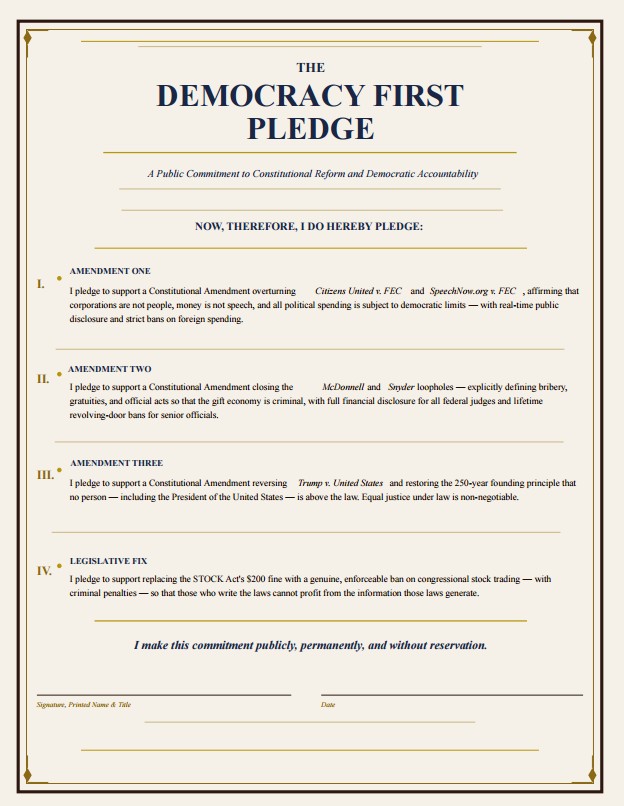
Download the official Democracy First Pledge (PDF) to share with your representatives.

VI. The Wall of Accountability — Dominance in Practice

Every candidate who signs goes on a public list: Committed to Democracy First.

Every candidate who refuses — or fails to respond — goes on a separate public list: Uncommitted to Anti-Corruption.

Note what the second label does. It does not accuse. It describes. The candidate made that choice themselves. And in a primary, that description is a weapon.

This is the Norquist mechanism applied to the predator problem. Binary. Public. Permanent. And backed by the credible threat of electoral consequences — organized, district-by-district constituent pressure of exactly the kind that Represent.US’s Congressional Courage Campaign has already proven can move members of Congress.

The Wall of Accountability is self-updating. Every signing is an event worth amplifying. Every refusal is content. The question “Why did [Candidate X] refuse to sign the anti-corruption pledge?” is a story that writes itself — and in the age of social media, it writes itself at scale.

VII. The Grassroots Engine

The pledge mechanism only works if it is fed by organized constituent pressure. That means a coordinated grassroots social media campaign — not just sharing content, but driving specific, targeted action: citizens in specific districts contacting their specific representatives with a specific ask.

Not: “Tell Congress to support democracy.”

But: “Call Representative [Name] and ask them to sign the Democracy First Pledge committing to a Constitutional Amendment overturning Citizens United, closing the McDonnell and Snyder bribery loopholes, and reversing presidential immunity. If they refuse, ask them to explain why on the record.”

That is active construction. That names the actor. That is Shenker-Osorio’s framework applied to political organizing. And that is the kind of demand — specific, public, binary — that creates the accountability pressure Norquist understood and Fish is prescribing.

VIII. Why Constitutional Amendments Are Non-Negotiable — and More Achievable Than You Think

Here is the objection I anticipate: Constitutional Amendments are impossible. Two-thirds of both the House and Senate, then ratification by three-quarters of state legislatures — thirty-eight states. Generational timeframe. Unrealistic.

The polling says otherwise.

Survey data from the Center for Public Integrity found that 75% of Americans support a constitutional amendment overturning Citizens United — including 66% of Republicans and 85% of Democrats.16 A separate analysis found 74% support in “very red” congressional districts and 76% in “very blue” ones.17 This is not a partisan issue among voters. It is only a partisan issue among the politicians the Predator Class has purchased.

Twenty-two states and hundreds of cities have already passed resolutions supporting a constitutional amendment.18 A Republican-sponsored bill in Missouri — not exactly a bastion of progressive politics — would make it the 24th state to call on Congress to act.

The procedural hurdle is real. Two-thirds of Congress means 290 votes in the House and 67 in the Senate. Ratification requires 38 states. That is not a short-term project. But it is not an impossible one — and crucially, it is the only project that produces a durable result.

Maine proves the point. Voters passed campaign finance reform with 75% support. The courts began dismantling it under the very legal architecture the reform was designed to fix. Every legislative win without an amendment is temporary. The Predator Class has built a legal system specifically designed to protect itself from democratic reform. Only an amendment is beyond its reach.

The political will of elected officials is the missing variable. That is exactly what the pledge mechanism is designed to supply.

IX. The Argument in One Sentence

The Predator Class has spent decades building a legal architecture that allows it to hunt without consequence. The Democracy First Pledge is how we build the architecture that makes hunting costly.

Not a petition. Not a scorecard. A blunt instrument, wielded with the confidence, specificity, and moral clarity that Fish and Shenker-Osorio tell us is the only thing that actually works against dominant power.

They are unanimous in their hate for this agenda. Welcome their hatred.

References

1. Richardson, H. C. (2026, March). Letters from an American [Video]. YouTube.

https://www.youtube-nocookie.com/embed/wvAzJqEosyg?rel=0&autoplay=0&showinfo=0&enablejsapi=0

2. Hughes, C. M. (2026). Epsteinland: How power really works and how we take it back [YouTube series and Substack]. https://christopherhughes.substack.com

3. Galbraith, J. K. (2008). The predator state: How conservatives abandoned the free market and why liberals should too. Free Press.

4. Meyer, D. (2003, November 26). The predator class. CBS News. https://www.cbsnews.com/news/the-predator-class/

5. Represent.US. (n.d.). The American Anti-Corruption Act. https://represent.us

6. Friedman, M. (1970, September 13). The social responsibility of business is to increase its profits. The New York Times Magazine.

7. Federal Election Commission. (1976). Buckley v. Valeo, 424 U.S. 1 (1976). https://www.fec.gov/legal/court-cases/buckley-v-valeo/

8. Citizens United v. Federal Election Commission, 558 U.S. 310 (2010). https://www.supremecourt.gov/opinions/09pdf/08-205.pdf

9. SpeechNow.org v. Federal Election Commission, 599 F.3d 686 (D.C. Cir. 2010). https://www.fec.gov/legal/court-cases/speechnow/

10. McDonnell v. United States, 579 U.S. 550 (2016). https://www.supremecourt.gov/opinions/15pdf/15-474_ljgm.pdf

11. Snyder v. United States, 603 U.S. ___ (2024). https://www.supremecourt.gov/opinions/23pdf/23-108_e2p3.pdf

12. Trump v. United States, 603 U.S. ___ (2024). https://www.supremecourt.gov/opinions/23pdf/23-939_e2p3.pdf

13. Fish, M. S. (2024). Comeback: Routing Trumpism, reclaiming the nation, and restoring democracy’s edge. University of California Press.

14. Shenker-Osorio, A. (2012). Don’t buy it: The trouble with talking nonsense about the economy. PublicAffairs.

15. Norquist, G. (1986). Taxpayer Protection Pledge. Americans for Tax Reform. https://www.atr.org/pledge

16. Balcerzak, A. (n.d.). Study: Most Americans want to kill ‘Citizens United’ with constitutional amendment. Center for Public Integrity. https://publicintegrity.org/politics/study-most-americans-want-to-kill-citizens-united-with-constitutional-amendment/

17. Washington Monthly. (2020, July 25). A realistic strategy for overturning Citizens United: 74% support in ‘very red’ districts, 76% in ‘very blue’ ones. https://washingtonmonthly.com/2020/07/25/a-realistic-strategy-for-overturning-citizens-united-within-10-years/

18. Brennan Center for Justice. (2025, January). Fifteen years later, Citizens United defined the 2024 election. https://www.brennancenter.org/our-work/research-reports/fifteen-years-later-citizens-united-defined-2024-election

19. Congress passed the STOCK Act in 2012 (Pub. L. 112-105). For analysis of its enforcement failures, see Epsteinland Episode 4: “How They Made Corruption Legal.” https://christopherhughes.substack.com

Christopher M. Hughes, MD is a retired ICU and hospice physician from Pittsburgh, Pennsylvania. He writes on health policy, political economy, and democratic accountability.


Inevitable.

As I mentioned in my last post, I am very keen on the idea of framing our political arguments and positions as inevitable. It comes from Anat Schenker-Osorio (ASO) and her argument that inevitability can overcome many cognitive psychology biases, like Status Quo Bias and others that I explore in a series of pieces here.

She believes that the success of the campaign for abortion rights in Ireland was greatly benefited by the framing around inevitability: We are eventually going to do this, why not do it now and create a better world with less suffering now instead of waiting for all of the old guard to pass on?

I believe there are many issues we can frame like this, and I am hoping some of you will help me brainstorm this. I am going to put up some issues (and my initial stab at framing) that I think are inevitably going to change in progressives’ favor as Gen Z starts voting in bigger numbers and my Boomer cohort votes less.

  1. Gun Control. Seeing the demonstrations in Tennessee and the polling numbers on assault weapons bans, and the general unpopularity of crazy “guns’ rights” positions, makes this seem like it should be easy.
  2. Reproductive Rights. Quashing reproductive freedom is the last gasp of religious patriarchy.
  3. Green Energy Transition. I would like to say that the fossil fuel industries are in their last days, too, but the power they wield is still immense. But the transition is mandatory and we all know it. The longer we postpone the inevitable, the more harm we do to everyone.
  4. Workers Rights. Union rights, fair and living wages, sharing of profits across the work force (like we did in the decades after WW II), Child labor laws, a four day work week, to name a few. Does anyone think we aren’t going to get these things as we push back against the oligarchs?
  5. LGBTQ Rights. Also part of the last gasp of the religious patriarchy. Religious zealots gonna scream about “the gays” and continue to look the other way while their children are abused. Enough.
  6. Universal Healthcare. Is there a universe that in 10-20 years still does not have universal healthcare? As with the fossil fuel industry, the Medical Industrial Complex will be hard to fight, but I have many thoughts on how to do it, and I am not alone.
  7. Finally, the Big One: SCOTUS. Everything listed above can be overwhelmingly popular but if the reactionaries currently in control of SCOTUS remain in control, they can invalidate every bit of progress with the wave of their corrupt hands. I believe it is inevitable that we unpack the Court. McConnel and Trump packed it with reactionaries and religious fundamentalists, and that is not who we are as a country. It must be undone, so let’s get on it now. Mobilize to unpack the court.

There’s my list. Please contribute your thoughts and criticisms, I’m anxious to see if this can get some legs!

Reconciling Anat Schenker-Osorio, Mariana Mazzucato, Jonah Berger, Dan Ariely, Anand Giridharadas, and me.

I have been following the work of Anat Schenker-Osorio, hereafter ASO, for quite some time. But lately I’ve become more of a fan. I found an interview with her from “The Zero Hour with RJ Eskow” podcast from about three years ago. It covered a fair amount of territory for a short interview, and I thought it be worth summarizing and commenting on to help with my own clarity of thinking as I try to synthesize lots of cognitive psychology material around persuasion and changing peoples’ minds. So here we go!

First, Anat Shenker-Osorio is the author of the book “Don’t Buy It: The Trouble with Talking Nonsense About the Economy.” She is also a consultant and advisor in the field of communication and strategic communications, and the host of the podcast that was called “Brave New Words,” and is now called “Words to Win By.”

As has been said many times by many people, our choice of words when making our persuasive arguments matters. It matters a lot. She gives the example here of the difference between talking about the price of a prescription drug versus the cost of a prescription drug. She points that cost implies inherent value while price is simply an arbitrary number assigned by typically, someone trying to sell the item. Cost implies an inherent value and perhaps the cost of producing something. (She later mentions talking about insurance corporations rather than insurance companies as another example.)

This argument ties into another discussion I have recently become interested in from Prof. Mariana Mazzucato, who argues that without a clear understanding of value creation, we risk allowing value extraction to masquerade as value creation, leading to a distorted perception of productivity and value in the economy. In other words, in the same pharmacy example, there is value creation, but it lies with the underlying research, typically done in federally funded institutions, and with the actual whitecoat scientists in the pharmaceutical companies. Contrarily, the value extraction in the industry comes from the administrative and executive overload of trying to name prices that are extraordinarily out of step with the actual cost and value of a product.

ASO argues that the “way we describe these policies makes a measurable difference in terms of both who is persuaded to understand and support them, and equally, if not more importantly, how we galvanize are base to repetition so that our version of the story is the one that’s actually able to dominate” in public discourse. If there is one thing the Democrats are bad at, it’s staying on message and repeating the message ad nauseum. We have a lot to learn from our political opponents on this!

She continues that it’s not simply about convincing people that our ideas are better, but it is contending with the cynicism of the public, particularly in healthcare, that change is even possible. She notes that they are also scared to death of getting rid of the devil they know.

She then makes two arguments about this:

  • Describing policy and making cogent arguments will never overcome the fear of uncertainty.
  • Arguing for the financial and economic benefits for something that is essentially an argument about our morality as a nation is never going to work.

The uncertainty argument is critically important. Jonah Berger, in The Catalyst, Chapter 4, reviews the literature on loss or risk aversion. People really dislike uncertainty. Uncertainty undermines actively making changes and can halt the decision-making process entirely. “[W]hile uncertainty is great for the status quo, or whatever people were doing before, it’s terrible for changing minds.” “Status quo bias” or favoring something simply because it’s this certain thing that we already know and have is powerful. As Uwe Reinhardt put it long ago, “everybody’s second choice is the status quo!” Therefore, it wins. More here.

The second part of her argument is an echo of a chapter in Dan Ariely’s book, Predictably Irrational. In Chapter 4, “The Cost of Social Norms,” he describes how differently we process decisions based on whether the appeal is to “market norms” or “social norms.” He gives the example of asking a lawyer to do pro bono work for a good cause versus asking a lawyer to do work at discounted rate for good cause. They will nearly always do the former and almost never the latter. Once a rate of exchange is applied to the transaction, it becomes a market transaction and the appeal of doing something as a social good is out the window.

So ASO’s point about not making the typical liberal nitty-gritty detailed policy argument about the market benefits of universal healthcare is spot on. The argument has to turn on social justice and moral norms.

She further emphasizes that point by noting, as would George Lakoff and Drew Westen, that when you make the arguments as financial and economic you activate the parts of the brain, the neurologic pathways that favor conservative arguments of fear of the unknown. And besides, as far as energizing the progressive base, it really isn’t about the economic arguments, even as persuasive as they are, it really is about the moral argument. I know it is for me.

She gives three examples of progressive campaigns that she participated in including the fight for abortion rights in Ireland, the campaign for prime minister in New Zealand, and an anti-racism campaign in Minnesota. She points out that messaging around being against things really doesn’t work well. Progressives need to figure out how to forcefully state what we are in favor of. “Abolish ICE,” for example. It is better as an argument to “create fair immigration process that respects all families.”

One of her central points tying these three campaigns together is the idea of the inevitability of change. Rather than trying to convince people that change was necessary, argue that change is necessary and inevitable. In the abortion example particularly, this was about getting the change over with, because it painted Ireland as backwards and out of step with the modern world. I think the same argument applies directly to America and universal healthcare. We will eventually do this, what are we waiting for? It makes us look bad: selfish, uncaring and backwards. We should lean into that.

Anand Giridharadas in an appearance promoting his new book, The Persuaders, makes a good case for reframing Medicare-For-All as “FreedomCare” in a recent “Off-Line with John Favreau” podcast:

Let’s help people see themselves in Medicare for all. I would call it FreedomCare. I think it’s ridiculous that it’s that it’s called Medicare for all. Why is it named after a government program instead of a widely held American value that would be an example of sticking to the ambitious demand, but saying what are some other ways of talking about it, right?

A language of freedom is a much more resonant language in this country. Healthcare is a human right is something that people – progressives – often say about Medicare for all well that’s actually not a particularly resonant frame in America because it’s not like the people who don’t like universal healthcare also don’t like human rights, right?

What I think universal healthcare would be in truth would be a massive expansion of human freedom in this country. Like I don’t want my boss dictating whether my kid gets care if, heaven forbid, my kid gets cancer. Did you want your boss having that decision over you, right? Yeah, like I don’t want to not pursue my business idea because I have to stick to a stupid job for healthcare.

It’s amazing to me how little progressives speak in this kind of language of personal Liberty around the stuff. That’s the kind of persuasion that I think the characters I’m writing about are interested in.

But let me tell you where she really made me a fan: she wants us to name the villains! This is something I have been pushing in my circles for quite some time, so it is great to hear it validated! She talks about the positive messaging and to say what we are for, but she doesn’t discount the importance of name checking the problem and deliberately naming the villains! She uses the example of the 2009 housing crisis: people didn’t lose their homes, their homes were taken from them by Jamie Dimon and J.P. Morgan Chase and all their collaborators. We have to lose the passive construction of our arguments and assign deliberate causation to the actions of the “malefactors of great wealth.”

There are hundreds of ways that this will work in healthcare. In fact, if you ask Chat GPT who the five highest-paid health plan insurance corporation executives are, it’ll tell you.

1. Bruce Broussard, Humana – $17.3 million

2. Joseph Swedish, Anthem – $13.1 million

3. Stephen Hemsley, UnitedHealth Group – $12.4 million

4. Kenneth Burdick, Cigna – $11.6 million

5. Andrew Slavitt, Optum – $10.8 million

Her final point is based on a quote from Keith Ellison, Atty. Gen. of Minnesota who said, “power knows exactly what it’s doing.” The argument is that speaking truth to power is not enough. The goal is to achieve enough power and force change. FDR allegedly said to a group of activists, “You’ve convinced me. Now go out and make me do it.”

Let’s do that.

Supporting Progressive Ideas and Messaging for the Next Generation.

I am very worried that we progressives have strong majority support on almost every major issue facing America and yet we keep letting the Right Wing Noise Machine define us as “far left” and “radical” and “socialists/communists” and all kinds of things they think are epithets.

Perhaps the major difference between why they are successful in pushing their narratives and we are not is because they invest in their people and their messaging!

First, people. Bruce Bartlett, a disillusioned conservative who served under Reagan and Bush and later came to say that:

I had previously viewed Krugman as an intellectual enemy and attacked him rather colorfully in an old column that he still remembers.

For the record, no one has been more correct in his analysis and prescriptions for the economy’s problems than Paul Krugman. The blind hatred for him on the right simply pushed me further away from my old allies and comrades.

Bartlett is someone who has been in the rooms with big donors. At a recent event featuring Michael Tomasky for his book Middle Out Economics, at the Politics & Prose Bookstore, he said this (pulled from the transcript and edited for clarity by me):

I know and I’m not the only one who knows a lot about how the right got to its position of enormous power and influence and a lot of what it did could be copied, but the left adamantly refuses to do it.

…for example there are vastly more “right-wing” think tanks then there are left-wing thing tanks there are vastly more right-wing New Republics than there are liberal publications of that sort. And it simply boils down to resources. The right has vast resources but the left is not powerless. There are lots of progressive billionaires and if you look at the aggregate data for campaign contributions Democrats raise just as much if not more than Republicans.

It just seems to me that the left spends its money very, very ineffectively…

…I started to read your chapter about the foundations … and I’ve heard a lot of things. I’m not a person of the left. I’ve not dealt with these people directly but I’ve always heard for example that Progressive foundations give money for specific projects and they insist that the money be used only for that project and all that sort of thing, whereas the right [gives] money [for] General purposes and this gives the right wing foundations vastly more flexibility to adjust and take advantage of changing opportunities.

Also I think Progressive groups (at least non-profits) get a lot more [of] their money from foundations which by their nature carry certain strings attached whereas the right gets a lot more of its money from Individual wealthy people. I’ll tell you just one thing. Back when I was still working for the right I was at a reception and I was talking to one of our richest donors of the organization I was working for and I was very curious: how do you decide how much money or who to give it to, and he said in my mind I’ve got a budget for politics and all the money I give to politicians or to tax-exempt organizations all comes out of that budget. And I was flabbergasted because I thought, well, isn’t our tax exempt status worth something? And he said… you know it’s not that important. [And] that always just stuck with me as something that I’ve never quite figured out in terms of how you attract wealthy people and mobilize them and get them to give money. Just today I was reading something about the Heritage Foundation a huge percentage of their income comes from bequests. Some of these bequests were made decades ago and now the money is pouring in and so it takes time and I just wonder whether the left is just not really up to speed about doing the things that get this stuff into motion and gives allied organizations and publications the resources to compete.

In addition to supporting their foundations and publications, they fund their people, often through non-profit entities that house their people. There are lots of them, and in my healthcare world, there are a core corps, as it were, of them: Avik Roy, Betsy McCaughey, Grace Marie Turner, and my least favorite, Sally Pipes. Pipes runs the “Pacific Research Institute,” where right wing money keeps the lights on and pays her very well to do her thing, which is spreading fear and misinformation about Universal Healthcare.

They invest in people. As someone who has helped with fundraising for a progressive organization, I can tell you the progressive foundations want return on investment, measurables, and finite projects, just as Bartlett reports. This remains a recipe for ineffectual advocacy. It needs to change.

Messaging. The high priest of conservative messaging is emblematic of conservatives supporting people and messaging. You all know who Frank Luntz is, so I won’t expound further, suffice it to say that his work has advanced conservative causes more than any group of conservative politicians since Reagan. Except maybe Grover Norquist.

There has been recognition on the left that we need to do better with our messaging. In fact, we have some great thinkers in this area: Anat Shenker-Osorio, Drew Westen, David Broockman and Joshua Kalla, and the venerable George Lakoff, among others.

Anand Giridharadas in his new book, The Persuaders: At the Front Lines of the Fight for Hearts, Minds, and Democracy, puts together some of the ideas applying cognitive science to changing peoples’ minds, a particular interest of mine. One of the points made (primarily through Anat Shenker-Osorio) is about not being afraid to promote and defend one’s principles and ideals, something near and dear to our DailyKos cohort! Another is about listening to people, as uncomfortable as that is, to create active listening, rather than reactance, which is essentially as they say at The Argument Clinic, the “automatic gainsaying of anything the other person says!”

I have learned a lot about how to become a persuader, through the work of cognitive scientists and I have gathered a lot of it here, with my emphasis on healthcare, but it apples to all progressive persuasion.

I am out of time, so will stop here, acknowledging I have a lot more development to do on the “messaging” half of this diary! Which is funny, because my original intent was to write a piece about creating messaging to persuade young people using young people as the creators of the messaging, based on a section of Jonah Berger’s amazing book, The Catalyst. He describes an antismoking program designed by young people that was remarkably successful because, he argues that the ads allowed for agency, the concept of presenting information and allowing for us to decide what to do for ourselves, rather than just being told what to do or how to think. Novel concept, right?

Cheers!

[Cross posted at DailyKos.]

Showing my work – why cognitive psychology and why a Kefauver-type commission?

In the interest of “showing my work,” and showing the process that got me to here, it occurred to me after writing my post about Political Sustainability of the US Healthcare System that I should share this. In 2014 I reached out to Don Berwick, Uwe Reinhardt, and a few others and had an interesting back and forth, particularly salient are Prof. Reinhardt’s remarks. Here’s a summary.

In 1997, Uwe Reinhardt asked a question of Americans and leaders of American health care in particular, “As a matter of national policy, and to the extent that a nation’s health system can make it possible, should the child of a poor American family have the same chance of avoiding preventable illness or of being cured from a given illness as does the child of a rich American family?”  While every other modern nation has answered this question affirmatively decades ago, the US remains stubbornly divided on the answer. Our debate in 2009-2010 over the Affordable Care Act and the resultant ongoing reverberations continues to punctuate this point.

Wanted: A Clearly Articulated Social Ethic for American Health Care

Uwe E. Reinhardt, PhD

JAMA. 1997;278(17):1446-1447. doi:10.1001/jama.1997.03550170076036

In 2014, Don Berwick published an editorial in JAMA pointing out that American factionalization, dating back to the Founding Fathers, has limited our ability to act, quoting Madison, “to the permanent and aggregate interests of the community,” insofar as health care is concerned.

He argued that the “antidotes to health care’s confiscation must include something bigger, more forceful. This is the time for mobilization—not just the intellectual mobilization of clever community projects but also the political mobilization that ended the Vietnam war, began to deliver on civil rights, birthed modern feminism, and started down the long road toward equal rights for the LGBT community.”

He continued, “Who can mobilize? It will not be the health care behemoth; it is not evil, but it is too big to change itself. Instead, change will require the collective political will of those who are losing ground every day to health care’s unbridled confiscation of the future: laborers who want to protect their families, business leaders who want to survive in a competitive economy, a better-informed citizenry who want health, not procedures, and health care professionals who want not the hassles of complexity but work that adds meaning to their lives. Quite frankly, it will require leaders with the courage to take on the factional control that Madison rightly feared.”

After reading this, I was moved to write Dr. Berwick, Prof. Reinhardt and some others. I will largely confine the rest of this to the insights of the late, great Professor Reinhardt.

I noted that nearly every physicians’ professional organization in the country have already endorsed the ABIM Charter on Medical Professionalism, including its call for social justice in healthcare:

I would venture that every medical school and every health professional school would love to participate in such a discussion. I could envision this as a building and sharing collective effort starting in one city with all of the above professional stakeholders, plus the faculty of schools of population health and other academics, experts in international systems such as yourself and Dr. Reinhardt, business leaders (Paul O’Neill comes to mind), citizens and advocates, and many more, presenting work and having conversations, passing those conversations in summary form to the next group, and eventually building to a point of consensus among an important and broad coalition.

Prof. Reinhardt responded to my initial email as well:

My wife Tsung-Mei Cheng and I were part of the creation of the Taiwan health system, especially in the initial global survey of which Dr. Hughes speaks. Tsung-Mei’s classic paper on the genesis of that system is attached. It explains in detail how that country exploited a unique window of opportunity to get universal health insurance coverage virtually overnight. She may want to chime in.

But the governance system in Taiwan at that time was rather different from ours (or from theirs today). The country then was run by a highly educated and highly motivated elite that appears to have reached early on a consensus on the social ethic that was to dive Taiwan’s NHI, namely, an egalitarian ethic. The elite structured the NHI according to that ethic. Among other things, it made that elite rule out the US approach as a model from the get-go. There wasn’t a plebiscite or referendum on the issue in Taiwan, although politicians appear to have sensed that the public craved protection from the financial inroads of ill health.  

As I once put it in a fairly angry essay that borders on Gruberism (after the failure of the Clinton plan; attached as well), the problem in the US is not that the plebs is confused. I believe in general that the plebs eats what it is served by a unified ruling elite it respects, here as elsewhere in the world. Recall how easy it was for a unified elite that had reached a consensus on invading Iraq, Hillary Clinton included, to make the public go along with that momentous decision even though, as country singer Alan Jackson so forthrightly puts it in one of his songs, many of the public probably did not know the difference between Iran and Iraq or what Iraq had to do with 9-11.

No, the problem in America is that the elite does not share a consensus on what the social ethic governing American health care should be. I am not sure it ever will reach such a consensus. So, in my view, any meeting of the sort you have in mind, Dr. Hughes, will end up as a Tower of Babel among the elite on the issue of social ethics. I made that point a while ago in debating Michael Cannon of the Cato Institute.

In my less cynical moments I have always found touching the solicitude with which America’s political elite professes to admire and consult the wisdom of the people whom, alas, that same elite spends so much time judiciously misinforming, to manipulate the public’s mind. In more somber moments I am reminded of de Tocqueville’s DEMOCRACY IN AMERICA (especially Chapter XV), in which he openly mocks that false solicitude when he writes that “the sycophants of Louis XIV could not flatter more dexterously” than does America’s political elite when it heaps praise upon the peoples’ wisdom. In fact, however, that political elite seeks “wisdom” and guidance mainly from the moneyed interest groups that are their financial patrons. What opulent operators of gambling dens think about in the shower in the morning, for example, surely counts for more in the way our country is run than does the wisdom of millions of the people.

True, the plebs is granted the right to change the actually ruling elite from time to time though general elections, but once in office that elite dances to the tunes of the moneyed special interests – often the same special interests, leading to the same dance by the elite in power. Was there really any significant difference in the way the Bush and Obama administrations dealt with the opulent miscreants of Wall Street? It all can explain, for example, why so many Americans simply have tuned out of the electoral system altogether and gone fishing. Therein, I admit, does lie a certain grassroot wisdom.

As it happens, I just got back from Taiwan where I delivered a lecture on The Political Economy of Health Care in the U.S. I made roughly the same points there.

Best regards,

Uwe

My response:

Uwe, would it be cheeky of me to say, “I feel your pain?”

I think it safe to say that the “liberal consensus” that resulted in LBJ’s Great Society and continued even far into Nixon’s presidency have taken on serious water in the past few decades, but I do think it is still there, in spite of, as Uwe points out, the misinformation being delivered to so many on a regular (and lucrative) basis.

Having said, that, I do believe there is much more consensus on what those of us in health care professions believe about social justice in health care than perhaps among the general public or the policy making elite. The public and elite hear what those with the most time and money in the system want them to hear, after all, and do not generally hear from the rest of us. I think voicing and amplifying that consensus and articulating it so that it can break through into regular public consciousness would not be a waste of time nor effort.

I do not expect to ever win over my uncle, a die-hard O’Reilly fan, but I could definitely work on my aunt…

Cheers,

Chris

Rethinking Conservatives Views on “the Undeserving”

In my post Friday, the discussion turned to conservatives’ views on universal healthcare, specifically about the deserving/undeserving paradigm. I have written about this before a great length, including in a piece called We’re Not Ready for Universal Healthcare (because we disagree on basic morality). I wrote about the voluminous evidence that conservatives puritanical mindset makes them suspicious of others and unwilling to consider social welfare benefits, including healthcare, because they might go to people that they consider “undeserving.” I presumed that the great majority of conservatives felt this way.

However, I have been working with a group called USA Healthcare, a group dedicated to getting past the usual left-right construction of arguments about universal healthcare. We decided that rather than presupposing what conservatives think, we would actually ask them. So, we did a survey of about 250 self-identified Republicans and asked them about our principles, namely universality, simplicity, and affordability. The results surprised me and I posted about them here in an article entitled, Maybe We Are Ready for Universal Healthcare?

The most salient points to our discussion are these:

  • Is healthcare a right? 32% of our cohort thought so! 42% agreed it was a necessity and 17% think of it as a public service good. Less than 10% thought of it as a consumer good!
  • Only 3% thought healthcare is deserved by only those who can afford it.
  • However, when asked straight up if healthcare should be universal 28% disagreed. 

I’ve documented my thoughts about this and the rest of the survey results, so I won’t repeat them here. But the reason I’m writing this is because I recently had a conversation with a friend from Utah who is part of a universal healthcare advocacy group in that state. He said one of the stumbling blocks they encountered was resistance to the word universal and the idea of universality. He attributed it to the same puritanical mindset of believing that there were truly people undeserving of our help and support.

It reminded me of something we had explored in our USA healthcare group previously, “Who exactly would you leave out of universal healthcare?” And, taken further for evangelicals and Mormons, “Who would Jesus leave out?”

I reminded my friend of our survey results showing that relatively few of our respondents seem to hold this “undeserving” position. He pointed out that in his experience, every Republican politician held this view. And I think he’s right.

But I think this is where our opportunity lies. As we discovered in our polling, with regards to all the elements of our USA triad, the ordinary Republicans who responded were not all that different in their assessments of the problems and solutions to the American healthcare mass as we had presupposed. I’ll let you review all of this for yourselves, but this could be a wedge issue, not Democrats v. GOP, but rather ordinary GOP identifying voters and their leadership. Ordinary citizens do not get the benefits of being in the pocket of the Medical Industrial Complex. No campaign or PAC donations, no lobbyists flattering them, etc.

Uwe Reinhardt called this Political Sustainability. I did a YouTube video about this, but basically it is the idea that even though healthcare is financially unsustainable for people who get sick and have to pay for premiums out of their wages, and even though it is economically unsustainable for us as a nation to keep paying these prices and having these bad outcomes, it remains sustainable politically. The money and influence of the Medical Industrial Complex makes it so!

Since I now realize I haven’t yet made the Political Sustainability  video into a blog post yet, I will do that this week for further discussion!

That’s all for now!

Show Your Work and become a “Scenius!”

So I watched this video, How Writing Online Made me a Millionaire, because I like the YouTuber and have been looking for tips on how to grow my YouTube Presence and blog more and better. It is largely about the concepts in the book Show Your Work, by Austin Kleon. I watched Austin talk about his work as well at his South by SouthWest talk from 2014. (Also, I am not sure if this is legal or why it is still up, but you can listen to the audiobook via YouTube here.)

The insights I have received have changed the way I think about blogging, YouTubing and moving forward on Healthcare Reform and Universal Healthcare.

Here are the first two things that were revelations to me: “Scenius” and “Process.”

Scenius is the concept that puts the lie to the “Great Man” theory of history. Alex Gentry at Medium has a nice exploration of this, but I will give mine, because I recently watched the movie CBGB, because we love Alan Rickman. David Byrne is a brilliant musician, but he was living across the street from CBGB’s in its heyday, interacting with the most innovative musicians in the world on a routine basis. Is he a genius? Maybe, but he’s also a “Scenius,” the term coined by musician Brian Eno to describe this effect. Read the Medium piece for the details.

Process, as in “trust the process.” For me, anyway. I think the author means more than this, but for me it is about letting go of trying to create fully formed projects, be they YouTube videos or developing a Healthcare in America Commission, or deconstructing Healthcare.

But what it also means is trusting that putting stuff out there, like this piece here, and generating interest and collaborators, and giving props to the people who inspire us, will create a community. The community will find its members. How many times have you searched the internet for something and couldn’t find anyone asking the same question as you? More often you can find someone asking that question, and that is the beauty of the internet.

I started a journey a few years ago trying to figure out a way to change peoples’ minds about Universal healthcare and I have found that there really isn’t anybody applying cognitive science to this problem. So here I am, a couple years later, much more knowledgeable, but without a large collaborative community to help it happen.

Chapter 3 is Share Something Small Every Day. After I read it I may commit to that, but for now, I will put this out there and try to share something most days, at least and see what happens!

This is my something for today. I am cross posting on my blog and my DailyKos diary.

How Equal Do We Want To Be – in Healthcare?

Along my journey in Cognitive Science I came to discover Dan Ariely, and then came across a TED talk he gave called How Equal Do We Want To Be?  He explores economic inequality and what we think we know about economic inequality, the reality of income inequality and finally what we would like income inequality to be. I think there are important correlations to how equal do we want to be in healthcare, and brought this here for discussion.

You can easily skip my summary of his talk and just go over and watch it, but I also wanted to capture some of the graphics, as I think with just a little imagination, they can be transformed into important questions about our healthcare system!

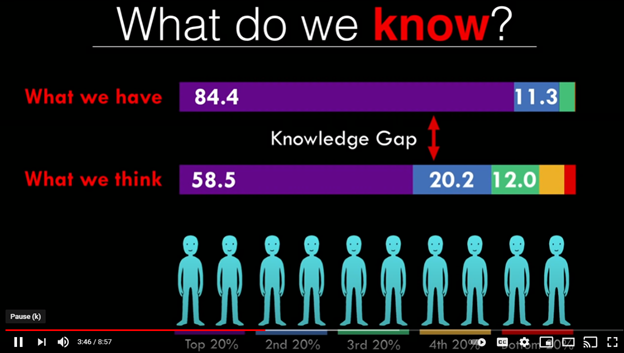
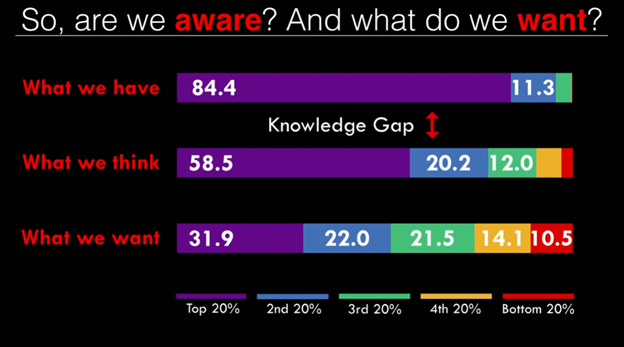
So, from the top! What we think is that the top 20% have 58.5% of the wealth and the bottom 40% have about 10% of the wealth.

In reality, the top 20% have 85% of the wealth the next 20% have 11% in the bottom 60% share the last 5%. He calls this difference between what we think and reality the Knowledge Gap.

Along those lines, he asks what we think the pay ratio of CEOs is to that of unskilled workers.  He shows this graph showing what people think it is (Estimated), when it actually is (Actual), and our ideal notion.

Not so bad, right? Oops, he didn’t adjust the scale. Here’s the reality.

We are in Alice in Wonderland territory now. But if you are in the CEO or top 20%, it’s a very happy Wonderland, indeed!

During the talk, Ariely references John Rawls and his theory of distributive justice.  He asked whether, if we could design our system, would we choose what we have?  So he asks, “How should the wealth be distributed?”

Quite a different picture!  The fairness is striking!  Sure, those at the top do better, but those at the bottom should not be destitute, either.  He calls this difference between what we think we have and what we want the Desirability Gap.

His last step is to ask us not only what do we think we know and what do we want, but what are we going to do about it?  This is the Action Gap.  There is much activity in the action gap of late.  (Well, maybe Bernie Sanders not just lately.)  But the recognition of massive wealth inequality finally seems to be making it into mainstream debates on policy in America for the first time in decades.

I will leave that larger societal question to others.  My lane is the healthcare line, particularly the fairness of healthcare lane, or the social justice Lane.  Ariely notes that he has done research about other areas of inequality including health, availability of prescription medications, life expectancy, infant mortality, and education.  He notes that we are even more averse to inequality in these areas than we are regarding wealth.  We are even especially averse to inequality when the individuals have less agency, like children.  (I would be interested in extending my research to see if it also applies to people born into all lower social economic statuses.)

I do not know if there is research on what Americans think about the injustices or performance of the US healthcare system.  I do know that most Americans know that we are not the best and no favor major changes or complete overhaul of the system.  And of course, we do know many of the realities.  We know we spend far more than any other nation and do not cover everyone.  We know we have very high out-of-pocket costs.  We know we have relatively low life expectancy and high infant mortality.  We know our citizens are less likely to survive serious illnesses.  We know that we have less physicians and our people see our physicians less frequently than other nations.

At a baseline, we do not even know what The US Healthcare Knowledge Gap is.  We do not know what the public does not know.  That makes it hard to get to the Desirability Gap, let alone the Action Gap.

Can we get by without knowing what the Healthcare Knowledge Gap is?  Maybe.  But it will be nearly impossible to move forward without knowing the Desirability Gap.

This will take some serious work.  Not only do we need to do the work to educate people on the reality of American healthcare, we then have to do research to find out what we,or at least what most of us, want to do.  After decades of watching progressives telling people that what they should want is single-payer, I know that telling people what they want is not the answer.  We need to do some work and we need to have some conversations and we need to come up with solutions.

What Are Physicians Willing To Give Up To Achieve Universal Healthcare?

One of the things that has troubled me for more than a decade is the way the medical profession declares that we favor an equitable distribution of healthcare resources and yet do little or nothing about it.  In 2002, the Physician Charter on Medical Professionalism in The New Millennium was published.  I will not bore you with the details here, but 2 provisions are important.  Commitment to improving access to care and commitment to adjust distribution of finite resources are clearly stated.  Physicians are exhorted to “individually and collectively strive to reduce barriers to equitable healthcare” and to be public advocates “without concern for the self-interest of the physician or the profession.”

This charter was signed by essentially every medical society and specialty organization that you can think of.  From the American Medical Association to the American Academy of Orthopaedic Surgeons and the American College of Radiology and on and on.  And yet, apart from lip service supporting improved access to health care, we have seen essentially no action. (I will be happy to entertain examples of such action in the comment section.)

We have theoretically signed on to the principles of universal healthcare and yet we have also been adamant in opposing and successful in preventing universal healthcare adoption. As a physician, I can find many malefactors for the lack of progression to universal healthcare in America. I don’t need to name them. You know who they are. And they will fight change with a white-hot intensity. As physicians, we can, and do, say “Why should we offer up anything when nobody else is willing to?” Maybe that is fair, but then why have the Charter? Why sign on to the Charter?

I can come up with many reasons why the medical profession has failed America in this area, but I have concluded that most important is that if we are forced to have a real conversation about universal healthcare, we will be asked to give something up and we are not prepared to do that. But until the medical profession steps up, is there really any hope? 

The transition to universal healthcare will involve some pain to all of us in the healthcare industry.  (Well, most of us anyway.  I expect nurses, respiratory therapists, and many other categories of healthcare workers to deservedly make out a bit better, at least!)  The question will be about how the pain will be divided.  This terrifies physicians.  It especially terrifies the highest-paid physicians.  It also causes angst among the lowest paid physicians and medical students.  Uncertainty is deadly to health care reform.

Consequently, I have been trying to figure out a way to have a conversation about this that makes sense and is fair to everybody.  As an aside, I have been telling my generational colleagues, this is not about us.  If we made sweeping changes legislatively tomorrow, most of us would be retired or at least close enough to it for any significant economic damage to happen to us.

While on my journey in cognitive science, I came across the philosophy of John Rawls.  Rawls was famous for his Theory of Justice, published in 1971.  At its heart is this: “A just society is a society that if you knew everything about it, you’d be willing to enter it in a random place.”  Rawls proposes the thought experiment in which we place ourselves behind a Veil of Ignorance, not knowing our position in society, and then construct the society.

Rawls was one of the most influential philosophers of the 20th century and it is horribly reductionist of me to sum his work up in a few sentences, but for our purposes this will suffice.  Imagine creating a physician reimbursement system and medical school tuition scheme not knowing whether you will be entering it as a radiologist, pediatrician, hospital or health plan administrator, orthopedic surgeon, or a medical student.  You do not know if you will be entering at the beginning of your career or at the end of your career.  How would you design the system?  How much would medical school tuition be?  At Georgetown?  At Wright State?  How much would a neurosurgeon make?  How much would a psychiatrist make?  What would be just?  What would be fair?

I propose Rawls’ construct is a strong starting point.  I can fairly confidently predict that many, if not most physicians will reject out of hand even contemplating this idea.  Fear and uncertainty are potent emotions against change, or even contemplating change.  But I think we can find a core of willing participants, and we can make an amazing experiment happen.  We can bring these people together and have this conversation.  Even if the result is just a conversation, it is a beginning.  It is the beginning of a discussion of what we as physicians expect from our profession and what we expect from ourselves as professionals. Are we to “individually and collectively strive to reduce barriers to equitable healthcare” and to be public advocates “without concern for the self-interest of the physician or the profession?”  Or are we to just continue to pay lip service to these ideals?

This discussion dovetails with a TED talk by Dan Ariely called How Equal Do We Want To Be? You’d be surprised. He explores economic inequality and what we think we know about economic inequality, the reality of income inequality and finally what we would ideally like income inequality to be. Please follow the link to the next portion of this writing…

Using Catalyst as framework for Moral Healthcare Chapter 1: Reactance

[These blog entries are my notes and takeaways from Jonah Berger’s amazing book, The Catalyst as I apply them to Universal Healthcare.]

The Need for Freedom and Autonomy

Berger, Jonah. The Catalyst: How to Change Anyone’s Mind (p. 20). Simon & Schuster. Kindle Edition.

Example 1: anti-smoking campaign based on telling teenagers not to smoke backfired. Same with the tide pod ad campaign with Grabowski. Simply telling people does not work. They push back-reactance.

What does work is amplifying freedom and autonomy. He uses the example of a nursing home where residents get more choice in their living arrangements and activities.

HCR Lessons:

Telling people that single-payer or some other solution is the correct answer will not work. It creates reactance. For me, I have thought for more than a decade that the solution is to provide people with memorable examples of excellent healthcare in other nations. This is based on the prospect theory ideas of recency and availability. Currently, when people are engaged about universal healthcare, recency and availability leads them to think of long wait times and rationed care. That is no accident. Conservatives have spent years and tons of money making it that way. They have a few choice anecdotes about sad stories of individuals in Canada or the UK and they can trot them out endlessly. They never get old, they reinforce what conservatives have been reinforcing for decades and so positions harden, rather than soften when we present examples of good care and other nations.

We have not done the groundwork to make the excellent care available in other nations recent and available. We need to do a lot of work showing how the choice is not between healthcare in a Soviet Gulag and the current mess we have now, rather it is between the current mess we have now and universal, simple, and affordable healthcare without wait times without the hassles and far cheaper.

We can further expand in this area by making clear that what we want in our freedom and autonomy is not which commercial health insurance plan we get to choose from-the lesser of a 1000 evils-but freedom to choose our doctors and hospitals and be the captain of our healthcare ship.

Prior authorization is freedom denied. High out-of-pocket expenses are freedom denied. Spending countless hours dealing with bills and explanation of benefit forms and appeals and the whole mess is freedom denied. Et cetera, the examples are endless. (BTW, we put together a piece in response to Frank Luntz’ 2009 guide to talking down the ACA, and it is pretty good along these very lines of thought.)

He points out that people are loath to give up agency. They have been told for decades that having employee-based health insurance is somehow agency. I think the experience of most of us with employer-based health insurance is anything but an exercise in autonomy. How many hours have we as individuals and as a society devoted to choosing among multiple health plans from our employer every year? If there were a choice that included near-complete coverage, minimal out-of-pocket expenses, no lifetime limits, unlimited choice of doctors and hospitals and basically what most citizens of developed nations expect as a given, who would not make that choice? Instead, our agency is to choose among the “cream of the crap,” as Paul O’Neill would say.

Reactance and the anti-persuasion radar.

People often take contrary position because they feel like they are being asked to do something. Not even commanded, just asked. People will even resist initiatives that they themselves wanted simply because they become mandatory or imposed in some way. Avoidance is the most common defense mechanism-simply ignoring the message. If they cannot avoid the message, they will cognitively shoot down every component of the message including content and source.

HCR lessons:

This is tough in these highly partisan times. Having content and sources that can at least partly tear down the barriers may end up being key. That is why I think that pairing doctors and nurses to deliver these messages might be key. Doctors are generally trusted, and nurses even more so. And as his corroborating evidence chapter discusses later on, having multiple sources from different areas is more powerful than, say, 5 doctors from PNHP.

Allow for Agency

Important discussion here about getting the perspective of the target audience. He uses the antismoking campaign example and tells how the team asked teenagers for their perspective on the antismoking campaign. They let the teens themselves craft the messages and in this case the messages of tobacco industry manipulation of the public and the political system. “Here is what the industry is doing, they said. You tell us what you want to do about it.”

HCR lessons:

Clearly this can be a powerful tool. We know what the medical industrial complex has been doing for decades. We can craft the messages straight out of Elizabeth Rosenthal’s An American Sickness, chapter by chapter!

I love the example of creating workbooks showing, exactly as Katy Porter did with Revlimid, exactly how pharmaceutical pricing impacts executive pay. (I think it would be also a fun exercise to show how that pricing translates into bonuses for the workers at the company, particularly the scientists who actually do the beneficial work in the industry.)

The other example about the teenagers calling out the magazine executive about not running anti-smoking ads as a public service practically writes itself when translated into healthcare. “Is this about people or about money?”

Berger notes that this campaign worked because it did not tell teenagers to stop smoking, it gave them information from their peers, and they were given agency to make a decision. This encourage them to be active participants rather than passive bystanders, Berger notes.

Creating agency reduces reactance and allows room for action. I can see campaigns pointing out the exorbitant costs of insulin or other medications, the “financial toxicity” of illness, and allowing the public to make up its mind about the acceptability of all this. Of course, there are thousands of other examples that doctors and nurses and health policy experts can give to create ads.

Four key ways to do that are: (1) Provide a menu, (2) ask, don’t tell, (3) highlight a gap, and (4) start with understanding.

Provide a Menu: Let them choose how they get where you are hoping they’ll go.

Provide the trade-offs upfront, as when negotiating salary versus paid time off in Berger’s example. Or, as one selecting off a menu at the restaurant-you are limited to what is on the menu, but there are still many choices. Or offering multiple choices of direction to a client when pitching something. Getting to choose between multiple options reduces reactance.

HCR lessons:

This is why I still I think the single-payer movement is doomed. It presents a single choice as the best choice and only choice.

Ask, Don’t Tell

The example here is a good one about asking students about their expectations of the hours required to prep for a GMAT exam. Basically, this is allowing for an interaction that lets the student figure out, by providing information and feedback, a more realistic study schedule.

This shifts the student from reactance and thinking of all the reasons to disagree or discount the information, the student becomes actively trying to figure out a real answer. Their opinion is valued.

Being able to ask questions increases buy-in. Asking questions that inform their thinking makes them participants in creating the best answer for them.

Berger writes that questions encourage listeners to commit to the conclusion. Asking the question framed around the student’s goals allowed them a path to the solution.

HCR lessons:

I went to the Mob Museum in Las Vegas a couple years ago. One of the things that caught my attention was the Kefauver commission. Sen. Kefauver went around the country holding hearings on organized crime and the effects on the communities he was visiting. This did 2 things. It raised awareness and humanized the crimes. They were no longer ephemeral.

When I was reading the section, I couldn’t help but think how powerful it would be to do sessions around the country with the goal of highlighting the negative effects of the medical industrial complex on ordinary people and then giving them the chance to ask questions of knowledgeable doctors and nurses about potential solutions. For me, this must be people knowledgeable about international healthcare systems. I think the answers are out there and we simply refuse to look for them. Having knowledgeable people be able to answer questions about how we solve X problem and being able to offer a tried-and-true international example would be powerful.

“It is a mistake for any nation to merely copy another; but it is even a greater mistake, it is a proof of weakness in any nation, not to be anxious to learn from one another and willing and able to adapt that learning to the new national conditions and make it fruitful and productive therein.” – Teddy Roosevelt.

Highlight a Gap: show the disconnect between what we do or think versus what we might recommend to others.

The important example in this section is about killing off something that is ongoing. He uses the example of a project within a business that is being proposed at the current moment would not be started, but as an existing ongoing project, it is hard to kill it. He attributes this to inertia and somewhere in another chapter he does talk about status quo bias and endowment.

HCR lessons: clearly this should be an important strategy for healthcare reform. I think there are very few people, conservative or liberal, who would create the US healthcare system as it is if they were designing a system from scratch. Some conservatives might argue for at least some of the pro-business, pro-market portions, but very few would argue to keep the system even close to what it is. And pulling confirms this, with a large majority of Americans thinking the system needs to be rebuilt entirely or have major changes. The cost of doing nothing in “blood and treasure” is enourmous.

Start with Understanding.

“Before people change, they have to be willing to listen.”

You cannot start a discussion jumping immediately to the outcome you want and expect people to come along. You must listen to them and understand them first. This requires understanding the other person, gaining insights appreciating their situation. Start by building a bridge.

Tactical empathy allows for not only showing compassion, it also allows one to gain valuable information. Using phrases like you and I, using us and we while working out and working towards solutions is of great value.

It is helpful if by using these techniques the other person feels as if the solution was their idea, or at least partly their idea. (Similar to the GMAT example.)

The other example he gives is not about a hostage situation, but about a suicidal father. The key here is pointing out to him his actions’ effect on his kids. “When people feel understood and cared about, trust develops.”

HCR lessons:

of course, these ideas are powerful in dealing with individuals, but I would circle back around to the Kefauver commission type events. Imagine talking to members of the audience, learning their concerns and developing trust. (As I am brainstorming this, I imagine some truly great ads could come out of the recordings of these sessions!)

Understanding their fears and concerns about transitions to universal healthcare are key. Just like in the Kaiser surveys, when asked about universal healthcare support is two thirds. Add to the question that one would lose one’s employer-based insurance, the support drops in half. This is natural, it is loss aversion. We need to understand the concerns of someone who has employer-based insurance and their fears. We need to allay those fears. We need to understand and offer solutions. In the case of developing a good universal healthcare system, the upsides are protean if you are aware of them. If not, you just think of care delayed and care denied. And, as part of my theme about our vast moral gap on these questions, transitioning to support of universal healthcare means letting other people “get over on you.” (A discussion for another article.)

There’s a Mark Twain quote, “Compassion is such a basic human emotion that it has even been observed among the French!” In spite of the fear of many of having other people get over on them, people are also generally compassionate. Uwe Reinhardt says something along the lines of “Americans are capable of both magnificent generosity and unfathomable cruelty.” The idea of talking about our children and our community’s children and their community’s disabled and poor and so on might be powerful. It would make for some interesting testing, but, it would be consistent with Kalla and Brickman and the deep canvassing techniques covered later in the book.

Berger, Jonah. The Catalyst: How to Change Anyone’s Mind (p. 83). Simon & Schuster. Kindle Edition.