
From the Epstein Class to the Predator Class — and How We Fight Back
Theodore Roosevelt called them the “malefactors of great wealth.” The phrase was precise for its time — men who did wrong with their fortunes, who corrupted the political system in which they operated, who treated democratic accountability as an inconvenience to be purchased away.
A century later, Heather Cox Richardson has given this network a name that I find more precise: the Predator Class.1 The term has roots — economist James K. Galbraith wrote of the Predator State in 2008,3 and CBS News’s Dick Meyer identified an “economic predator class” as early as 20034 — but Richardson applies it with fresh urgency to the network the Epstein files have now illuminated.
I want to use that phrase, because it is more accurate. A malefactor merely does wrong. A predator hunts. It selects targets. It is organized, patient, and systematic. It does not accidentally cause harm — it is structured around the causing of harm to others for its own benefit.
And yet it is worth pausing here to note that not every member of the Predator Class is a conscious predator. As I discussed in my Epsteinland series,2 the neuroscience of wealth and power is relevant: research shows that power literally suppresses empathy circuits, and that extreme inherited wealth conditions people from birth to see themselves as the heroes of their own story rather than as beneficiaries of a rigged system. For some — Jeffrey Epstein, Donald Trump — the predation is deliberate and knowing. For others, it is the predation of those who have so thoroughly internalized the mythology of the self-made American capitalist that they are genuinely oblivious to the harm they cause. They are the captains of industry that American culture has mythologized like no other society on earth. They do not see themselves as predators. They see themselves as the engine.
That self-perception does not reduce their culpability. It explains their confidence.
That is what the network revealed by the Jeffrey Epstein files actually is. Not a collection of individual wrongdoers. A class of people who have built a system — legal, financial, judicial, political — specifically designed to protect predators from accountability while ensuring that accountability falls with maximum force on everyone else. And in Donald Trump’s case, he now has the unprecedented and illegal power to engage in naked retribution against anyone who challenges that system.
I have been calling this network the Epstein Class, after Anand Giridharadas’s framing: Epstein as angiogram, injected into the system to reveal the full circulatory network of elite impunity.2 That framing remains useful. But Predator Class captures the behavior more precisely. And for what I want to argue in this piece, behavior is the point.
I. The Three Decisions That Built Epsteinland and Enabled the Ascendancy of the Predator Class
The Predator Class did not simply organically arise from the capitalistic ooze. It was architecturally enabled. Three Supreme Court decisions, taken together, constructed the legal infrastructure through which predatory power operates above accountability in twenty-first century America.
But before we get to those decisions, we need to back up further — because the legal architecture did not build itself in isolation. It had intellectual cover.
In 1970, Milton Friedman published his famous New York Times Magazine essay declaring that “the social responsibility of business is to increase its profits” and that any executive who considered broader obligations to workers, communities, or the nation was guilty of “pure and unadulterated socialism.”6 Friedman didn’t invent greed. He laundered it. He gave the Predator Class a Nobel-credentialed argument for doing exactly what they wanted to do anyway: extract maximum value, externalize every cost, and dismiss the public interest as sentimentality unworthy of serious men.
Conservative academics provided the intellectual cover. The economics departments of Chicago, Harvard, and Princeton produced the intellectual framework. And Ronald Reagan — along with the supply-side revolution he championed — translated that framework into policy, actively deregulating the constraints that had kept predatory capitalism in check since the New Deal. By the time Citizens United was decided, the Predator Class already had the academy, the think tanks, and the policy apparatus on its side. The courts simply completed the structure.
The destruction of legal accountability began not in 2010, but in 1976. In the aftermath of Watergate, Congress passed the Federal Election Campaign Act, establishing contribution limits and creating the Federal Election Commission. The premise was simple: unlimited money flowing from corporations and wealthy donors to politicians creates corruption. Cap the money, prevent the corruption.
The Supreme Court immediately began dismantling this premise. In Buckley v. Valeo (1976),7 the Court ruled that spending money in elections is a form of protected speech under the First Amendment. The seed was planted: money equals speech. For thirty years, Congress and the Court negotiated an uneasy truce. Then came the three decisions that completed the architecture.
Decision One: Citizens United v. FEC (2010)8
In January 2010, five Supreme Court justices held that corporations have the same First Amendment speech rights as individual citizens, and that spending money in elections is a form of protected speech. The practical consequence: unlimited corporate money flowing into American politics, laundered through shell PACs and nonprofit fronts into a system where roughly 50 billionaires now contribute more to campaigns than all small donors combined. Most people know Citizens United. Fewer know what immediately followed.
Decision Two: SpeechNow.org v. FEC (2010)9
Two months later, the D.C. Circuit applied Citizens United’s logic to hold that individuals could make unlimited contributions to independent expenditure groups. This is the decision that actually created Super PACs. Citizens United opened the door. SpeechNow.org walked through it. Together they converted American elections into an auction in which only the Predator Class gets to bid — and in which they largely control the legacy media that covers the bidding.
Decision Three: McDonnell v. United States (2016)10 and Snyder v. United States (2024)11
But unlimited money in elections was not sufficient protection for the Predator Class. They also needed assurance that once they bought access, using it couldn’t be prosecuted as bribery. The Supreme Court provided it — twice.
In McDonnell, the Court unanimously reversed the corruption conviction of Virginia Governor Bob McDonnell, who had received over $175,000 in gifts — a Rolex, designer clothing, vacation trips, $15,000 in wedding catering — in exchange for government meetings and promotional events. The Court held that none of this constituted an “official act” under federal bribery law. The Rolex was fine. The wedding catering was fine. The vacation was fine.
In Snyder, the Court went further. Mayor James Snyder of Portage, Indiana steered city contracts to a local company and received $13,000 afterward. The Court ruled 6-3 that federal bribery law does not prohibit gratuities paid after the official act. Justice Ketanji Brown Jackson wrote in dissent that the majority had handed every corrupt official in America a roadmap: pay the official after the fact, keep it informal, never put anything in writing, and the law cannot touch you.
Put these three decisions together and the architecture is complete. Citizens United and SpeechNow.org allow unlimited money to flow into politics. McDonnell and Snyder ensure that once access is purchased, using it carries no legal risk. The gift economy is not just tolerated — it is judicially protected. The Predator Class does not need to operate in the shadows. It operates in plain sight, in published Supreme Court opinions, quietly celebrated by the people who benefit from them.
And then there is a fourth ruling that extends the architecture to its logical conclusion: Trump v. United States (2024),12 which granted presidents sweeping immunity from criminal prosecution for official acts. The Predator Class at the apex of executive power is now, effectively, above the law by judicial decree. Remember when they used to howl about liberal judicial activists in the courts?
II. The Organization Already in the Field
Before I go further, I want to acknowledge something important.
I was in the middle of drafting this piece — specifically, a section about applying Grover Norquist’s pledge model to anti-corruption reform — when I came across Represent.US,5 an anti-corruption nonprofit that has been in this fight for over a decade. They have helped pass nearly 200 anti-corruption and pro-democracy reforms at the city and state level. They have organized millions of Americans across party lines. They have built the infrastructure — the volunteer networks, the legal frameworks, the mass communications operation — that any serious reform movement needs.
Their current Congressional Courage Campaign is doing important work: applying direct constituent pressure to individual members of Congress, district by district, demanding that they show independence and accountability. Their model is sophisticated, field-tested, and working.
The experience in Maine illustrates both the power and the limits of what is possible without a Constitutional Amendment. In 2023, Maine voters passed a comprehensive campaign finance reform measure with 75% support — a voters-versus-billionaires issue that crossed every partisan line in a purple state. And then the courts began dismantling it, under the very legal architecture the reform was designed to fix. Represent.US helped build that Maine victory. And they watched it get challenged in court. That is not a failure of their strategy. It is proof that legislative reform alone is insufficient — that the amendment must be the north star.
I am not proposing to duplicate what they are doing. I am proposing to add to it — specifically in areas where I think the movement needs a blunter weapon.
III. The Missing Pieces: Dominance, Specificity, and the Amendment Imperative
M. Steven Fish, the UC Berkeley political scientist whose book Comeback13 I discussed in Episode 5 of my Epsteinland series, argues that the opposition to Trumpism keeps losing because it keeps bringing a policy brief to a dominance contest. The Predator Class does not win because its arguments are better. It wins because its style is dominant — bold, unapologetic, emotionally compelling, organized around the projection of power.
Fish calls the alternative “high-dominance politics.” Not aggression for its own sake. But a political style that names things directly, signals strength rather than accommodation, and leads with moral clarity rather than technocratic nuance.
Anat Shenker-Osorio14 makes the complementary point from the messaging side. The messages that move people are not the policy briefs. They are the ones that trigger genuine moral emotion — anger at injustice, pride in doing right, shame at betrayal. Passive construction hides the actor. Active construction names the predator. “Millions of families lost their homes” is a tragedy. “JPMorgan Chase took millions of families’ homes” is a crime — with a name.
What I am proposing draws directly on both Fish and Shenker-Osorio. It is not a petition. It is not a scorecard. It is a mechanism designed to be as dominant and as specific as the problem it addresses. And so it also draws on Norquist.
IV. The Norquist Model — and Why It Works
Here is some important history, because the Norquist pledge did not emerge from nowhere.
Watergate produced reform. Nixon’s resignation produced Ford’s pardon. The pardon produced Carter. Carter produced Reagan. And Reagan — along with Newt Gingrich, who weaponized the House of Representatives as an instrument of political destruction — produced the conditions in which Grover Norquist could build the most effective single-issue political mechanism in modern American history.
In 1986, at Reagan’s urging, Norquist founded Americans for Tax Reform and began circulating a single piece of paper: the Taxpayer Protection Pledge.15 Candidates who signed it committed, in writing, to oppose all tax increases. The pledge was simple, public, and permanent.
It is worth pausing to note the irony: one could argue that after Reagan and Gingrich, Norquist was perhaps more responsible than any other single actor for cementing the political supremacy of the Predator Class. The pledge didn’t just protect low taxes. It locked in the policy architecture — deregulation, financialization, the systematic defunding of public institutions — that allowed predatory capitalism to operate without democratic check for four decades. We are proposing to use his own weapon against the system he helped build.
The pledge worked not because Norquist had superior arguments. Because he had a mechanism.
The pledge is binary. You signed or you didn’t. The pledge is public. Every voter in every district can look up their representative in thirty seconds. The pledge is permanent. Breaking it after signing is worse than not signing — the breach becomes the story. And crucially, the pledge was backed by the credible threat of a primary challenge. Any Republican who broke the pledge knew that Norquist’s organization would fund and support a primary opponent. That threat — real, specific, electoral — is what gave the piece of paper its power.
The result: a mechanism so effective that it reshaped what was politically thinkable for an entire party, on an entire issue, for four decades. Not through persuasion. Through accountability.
We need to build the same thing for anti-corruption reform. And it must be specifically directed at the legal loopholes the Predator Class has built to protect itself.
V. The Democracy First Pledge — Three Amendments and a Fix
The Democracy First Pledge asks candidates at every level — federal, state, and local — to commit in writing to support three Constitutional Amendments and one immediate legislative fix.
Amendment One: Reverse Citizens United and SpeechNow.org. Corporations are not people. Money is not speech. Regulated election spending is not pure First Amendment expression. Every dollar spent in American elections is traceable, disclosed, and subject to democratic limits.
Amendment Two: Close the McDonnell and Snyder loopholes. Explicitly define “official acts” and “gratuities” in federal and state bribery statutes so that the gift economy — luxury travel, post-act payments, influence peddling, prediction market bets tied to policy outcomes — is criminal. Full financial disclosure for all federal judges, including Supreme Court justices. Lifetime revolving-door bans for senior officials.
Amendment Three: Reverse Trump v. United States. No president, no official, no member of the government is above the law. For 250 years, that was not a radical proposition — it was the founding premise of the American republic. The 2024 ruling shredded that premise to protect one man. It cannot stand. Presidential immunity for criminal acts must be reversed, and the principle that no one is above the law restored to its constitutional foundation.
The immediate legislative fix: Congress passed the STOCK Act in 2012 — the Stop Trading on Congressional Knowledge Act — to prevent members from trading stocks on insider information unavailable to ordinary citizens. The penalty for violation: $200. A member of Congress earns $174,000 a year. Before the insider trading. The Act has never produced a single prosecution.19 Replace it with a genuine ban on congressional stock trading, with criminal enforcement. This does not require an amendment. It requires only the political will that the Predator Class has spent decades ensuring Congress lacks.
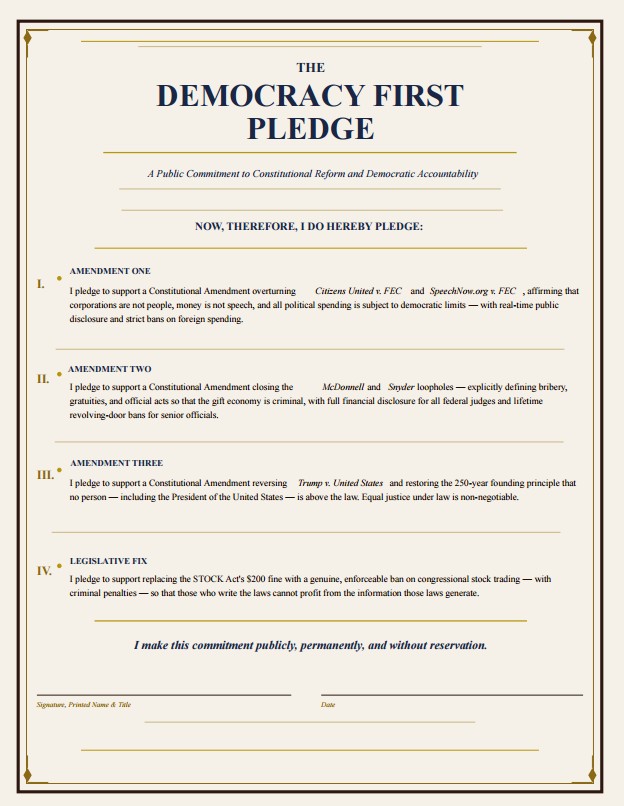
Download the official Democracy First Pledge (PDF) to share with your representatives.
VI. The Wall of Accountability — Dominance in Practice
Every candidate who signs goes on a public list: Committed to Democracy First.
Every candidate who refuses — or fails to respond — goes on a separate public list: Uncommitted to Anti-Corruption.
Note what the second label does. It does not accuse. It describes. The candidate made that choice themselves. And in a primary, that description is a weapon.
This is the Norquist mechanism applied to the predator problem. Binary. Public. Permanent. And backed by the credible threat of electoral consequences — organized, district-by-district constituent pressure of exactly the kind that Represent.US’s Congressional Courage Campaign has already proven can move members of Congress.
The Wall of Accountability is self-updating. Every signing is an event worth amplifying. Every refusal is content. The question “Why did [Candidate X] refuse to sign the anti-corruption pledge?” is a story that writes itself — and in the age of social media, it writes itself at scale.
VII. The Grassroots Engine
The pledge mechanism only works if it is fed by organized constituent pressure. That means a coordinated grassroots social media campaign — not just sharing content, but driving specific, targeted action: citizens in specific districts contacting their specific representatives with a specific ask.
Not: “Tell Congress to support democracy.”
But: “Call Representative [Name] and ask them to sign the Democracy First Pledge committing to a Constitutional Amendment overturning Citizens United, closing the McDonnell and Snyder bribery loopholes, and reversing presidential immunity. If they refuse, ask them to explain why on the record.”
That is active construction. That names the actor. That is Shenker-Osorio’s framework applied to political organizing. And that is the kind of demand — specific, public, binary — that creates the accountability pressure Norquist understood and Fish is prescribing.
VIII. Why Constitutional Amendments Are Non-Negotiable — and More Achievable Than You Think
Here is the objection I anticipate: Constitutional Amendments are impossible. Two-thirds of both the House and Senate, then ratification by three-quarters of state legislatures — thirty-eight states. Generational timeframe. Unrealistic.
The polling says otherwise.
Survey data from the Center for Public Integrity found that 75% of Americans support a constitutional amendment overturning Citizens United — including 66% of Republicans and 85% of Democrats.16 A separate analysis found 74% support in “very red” congressional districts and 76% in “very blue” ones.17 This is not a partisan issue among voters. It is only a partisan issue among the politicians the Predator Class has purchased.
Twenty-two states and hundreds of cities have already passed resolutions supporting a constitutional amendment.18 A Republican-sponsored bill in Missouri — not exactly a bastion of progressive politics — would make it the 24th state to call on Congress to act.
The procedural hurdle is real. Two-thirds of Congress means 290 votes in the House and 67 in the Senate. Ratification requires 38 states. That is not a short-term project. But it is not an impossible one — and crucially, it is the only project that produces a durable result.
Maine proves the point. Voters passed campaign finance reform with 75% support. The courts began dismantling it under the very legal architecture the reform was designed to fix. Every legislative win without an amendment is temporary. The Predator Class has built a legal system specifically designed to protect itself from democratic reform. Only an amendment is beyond its reach.
The political will of elected officials is the missing variable. That is exactly what the pledge mechanism is designed to supply.
IX. The Argument in One Sentence
The Predator Class has spent decades building a legal architecture that allows it to hunt without consequence. The Democracy First Pledge is how we build the architecture that makes hunting costly.
Not a petition. Not a scorecard. A blunt instrument, wielded with the confidence, specificity, and moral clarity that Fish and Shenker-Osorio tell us is the only thing that actually works against dominant power.
They are unanimous in their hate for this agenda. Welcome their hatred.
References
1. Richardson, H. C. (2026, March). Letters from an American [Video]. YouTube.
https://www.youtube-nocookie.com/embed/wvAzJqEosyg?rel=0&autoplay=0&showinfo=0&enablejsapi=0
2. Hughes, C. M. (2026). Epsteinland: How power really works and how we take it back [YouTube series and Substack]. https://christopherhughes.substack.com
3. Galbraith, J. K. (2008). The predator state: How conservatives abandoned the free market and why liberals should too. Free Press.
4. Meyer, D. (2003, November 26). The predator class. CBS News. https://www.cbsnews.com/news/the-predator-class/
5. Represent.US. (n.d.). The American Anti-Corruption Act. https://represent.us
6. Friedman, M. (1970, September 13). The social responsibility of business is to increase its profits. The New York Times Magazine.
7. Federal Election Commission. (1976). Buckley v. Valeo, 424 U.S. 1 (1976). https://www.fec.gov/legal/court-cases/buckley-v-valeo/
8. Citizens United v. Federal Election Commission, 558 U.S. 310 (2010). https://www.supremecourt.gov/opinions/09pdf/08-205.pdf
9. SpeechNow.org v. Federal Election Commission, 599 F.3d 686 (D.C. Cir. 2010). https://www.fec.gov/legal/court-cases/speechnow/
10. McDonnell v. United States, 579 U.S. 550 (2016). https://www.supremecourt.gov/opinions/15pdf/15-474_ljgm.pdf
11. Snyder v. United States, 603 U.S. ___ (2024). https://www.supremecourt.gov/opinions/23pdf/23-108_e2p3.pdf
12. Trump v. United States, 603 U.S. ___ (2024). https://www.supremecourt.gov/opinions/23pdf/23-939_e2p3.pdf
13. Fish, M. S. (2024). Comeback: Routing Trumpism, reclaiming the nation, and restoring democracy’s edge. University of California Press.
14. Shenker-Osorio, A. (2012). Don’t buy it: The trouble with talking nonsense about the economy. PublicAffairs.
15. Norquist, G. (1986). Taxpayer Protection Pledge. Americans for Tax Reform. https://www.atr.org/pledge
16. Balcerzak, A. (n.d.). Study: Most Americans want to kill ‘Citizens United’ with constitutional amendment. Center for Public Integrity. https://publicintegrity.org/politics/study-most-americans-want-to-kill-citizens-united-with-constitutional-amendment/
17. Washington Monthly. (2020, July 25). A realistic strategy for overturning Citizens United: 74% support in ‘very red’ districts, 76% in ‘very blue’ ones. https://washingtonmonthly.com/2020/07/25/a-realistic-strategy-for-overturning-citizens-united-within-10-years/
18. Brennan Center for Justice. (2025, January). Fifteen years later, Citizens United defined the 2024 election. https://www.brennancenter.org/our-work/research-reports/fifteen-years-later-citizens-united-defined-2024-election
19. Congress passed the STOCK Act in 2012 (Pub. L. 112-105). For analysis of its enforcement failures, see Epsteinland Episode 4: “How They Made Corruption Legal.” https://christopherhughes.substack.com
Christopher M. Hughes, MD is a retired ICU and hospice physician from Pittsburgh, Pennsylvania. He writes on health policy, political economy, and democratic accountability.

